Transformers
How Do You Test a Distribution Transformer
Distribution transformers are tested for resistance, turns ratio, insulation, and more. Learn the key tests to ensure proper transformer function.
Read More

Dry-type transformer Symbols models typically consist of a combination of letters and numbers, each representing specific technical characteristics. Below is an example and breakdown:
Other letter arrangement order and meaning of Dry-Type Transformer Symbols
(1) Winding coupling method: ** (not marked); self-coupling (indicated by O).
(2) Number of phases: single phase (D); three phase (S).
(3) Winding external insulation medium: transformer oil (not marked); air (G); gas (Q); molded solid casting type (C); wrapping type (CR); flame retardant liquid (R).
(4) Type of cooling device: natural circulation cooling device (not marked); air cooler (F); water cooler (S).
(5) Oil circulation method: natural circulation (not marked); forced oil circulation (P).
(6) Number of windings: double winding (not marked); triple winding (S); double split winding (F).
(7) Voltage regulation method: no-excitation voltage regulation (not marked); on-load voltage regulation (Z).
(8) Coil conductor material: copper (not specified); copper foil (B); aluminum (L); aluminum foil (LB).
(9) Core material: electrical steel sheet (not specified); amorphous alloy (H).
(10) Special purpose or special structure: sealed (M); series connection (C); starting (Q); lightning protection (B); capacity adjustment (T); high impedance (K); ground station traction (QY); low noise (Z); cable lead-out (L); isolation (G); capacitor compensation (RB); oil field power lighting (Y); plant transformer (CY); fully insulated (J); synchronous motor excitation (LC).
The connection method of dry-type transformers is often represented by codes like “Dyn11.” Below is a breakdown of common symbols:
| Symbol | Meaning | Features |
|---|---|---|
| Y | Star connection | Includes neutral point, suitable for three-phase four-wire systems |
| D | Delta connection | No neutral point, ideal for balanced loads |
| n | Neutral point lead-out | Provides zero line |
| 11 | Clock notation | Secondary voltage leads primary voltage by 30° |
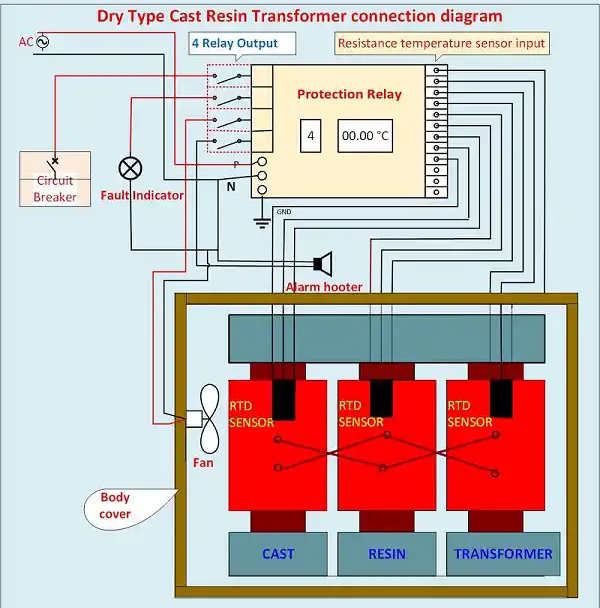
The nameplate on a dry-type transformer contains essential parameters that help buyers understand its performance:
Choose the right product based on symbols:
Distribution transformers are tested for resistance, turns ratio, insulation, and more. Learn the key tests to ensure proper transformer function.
Read More
Learn the key factors and calculations for properly sizing a distribution transformer for your electrical needs.
Read More
Learn about the fundamentals, types, applications, and safety considerations of high voltage power transformers.
Read More